
Rockville Centre City Directory Collections
Rockville Centre does not have a verified continuous printed city-directory run. Its strongest documented shelf is a set of local telephone directories held by the Rockville Centre Public Library, with some digitized material available through NY Heritage. The books can support a historical name, phone, street, address, or business listing, but their inclusion rules differ by edition. Date each observation and identify the kind of volume before treating it as evidence. A telephone book, an alphabetical directory, and a street listing can answer different questions.
| Collection | Located years or extent | Repository | How to use it |
|---|---|---|---|
| RVC telephone directories | 1923-24; 1938; 1946-57 with gaps; later selected holdings | RVC Public Library archives and NY Heritage | Search a dated name, phone, street, address, or business listing |
| Local newspapers | Runs have gaps | RVC Public Library and NYS Historic Newspapers | Use OCR as a lead, then check the page image |
| Historic Rockville Centre maps | Seven described map items, including a 1906 Lower RVC map | NY Heritage and library resources | Preserve the sheet, date, lot, and street context |
| Local reports and digests | 1943-2019 in uneven runs | RVC Public Library finding-aid boxes | Locate civic events, organizations, and public notices |
| Historical Society holdings | Item-specific dates | Museum of the Village of RVC | Use house-history and subdivision material as leads needing corroboration |
The documented holdings are valuable because they identify real editions and repositories. For a Rockville Centre search, they also establish what can actually be checked. A missing year may reflect an unsaved issue, a library acquisition gap, or a volume that has not been digitized. It does not establish that a person left Rockville Centre or that no directory was published.
Rockville Centre Telephone Directory Runs
The library finding aid lists 1923-24, 1938, regular and special editions from 1946-47 through 1956-57, a 1962-63 special edition, 1966-67, 1978 regular and special editions, then 1982, 1983, 1994, 1995, 2009, 2011, and 2012. NY Heritage describes about a dozen local telephone directories, particularly in the 1923-1957 period, with gaps. That is a strong foundation for a dated Rockville Centre listing trail, but it is not a year-by-year resident census.
The NY Heritage historic telephone-directory collection identifies the digitized local resource and its collection context.
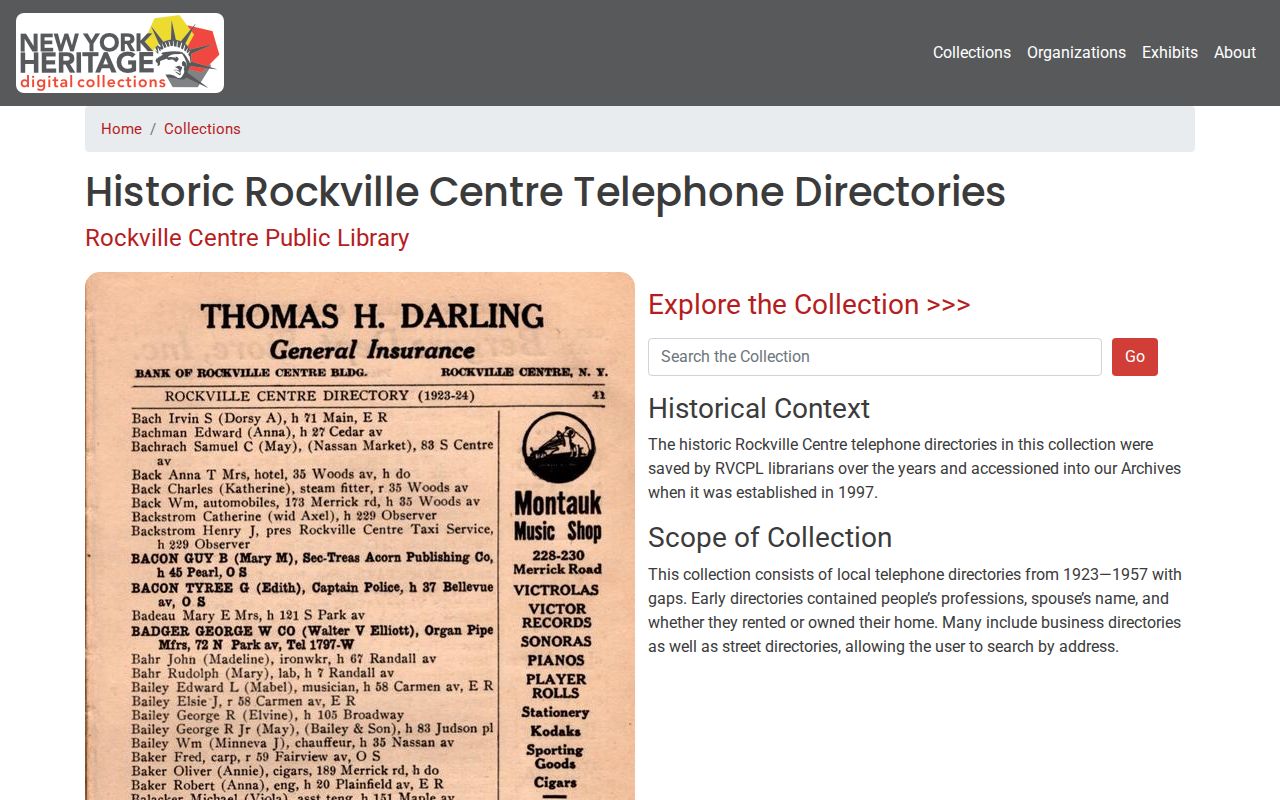
The collection view is useful for locating an edition before making a claim from it. An item title or collection description does not substitute for an interior page, so retain the page or image reference whenever a listing is used.
Early books may include a name, phone, address, spouse or household indicator, and a historical descriptive or business field. Some also have address-keyed material. Those fields are clues from the printed edition, not a modern profile. Where an edition offers a street listing, start there for an address question and then compare the alphabetical entry.
Note: Record the edition date and page before comparing any two Rockville Centre listings.
Rockville Centre Directory Archive Desk
The Public Library is the local bridge between digitized finds and materials that need a reference inquiry. Its archives page links local newspapers, NY Heritage, History Makers interviews, 90 Seconds in Time, HeritageQuest, FamilySearch, vintage-map resources, and Historical Society materials. The local-history resources also describe microfilm, cemetery, newspaper, and genealogy leads. Reference and circulation records remain private, so collection research should be about a published item, not another patron.
The Rockville Centre Public Library Archives page gathers those local-history routes in one place.
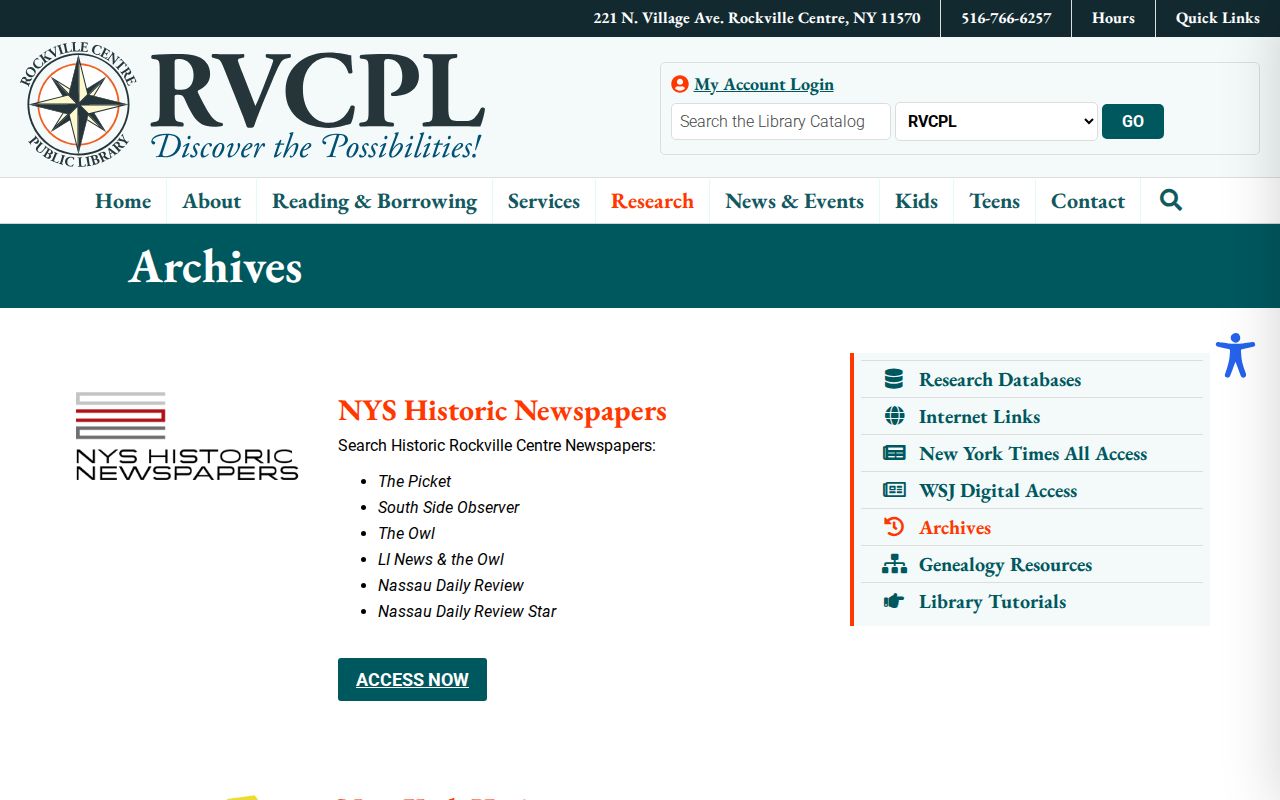
The archive inventory helps a researcher choose a precise request: collection title, edition date, item type, and the question being tested. Ask whether a scan is available, whether an appointment is needed, and whether a reproduction has conditions before relying on a shelf or microfilm item.
Library staff can help distinguish a telephone directory from a newspaper, map, oral-history item, or local report. That distinction matters in Rockville Centre. A newspaper may date an event more closely than a directory, while a directory can place a listed name at an address without proving the date of a move.
Rockville Centre Directory Map Clues
A historic address can be easier to understand when it is paired with a map rather than forced into a current street pattern. The NY Heritage collection includes a 1906 Lower Rockville Centre map scanned as a grid. Its rows and columns use identifiers such as L_1_A. Save that identifier, the map date, nearby cross streets, and a visible landmark before connecting the map to a later parcel search.
The Rockville Centre historic-map collection is the appropriate place to locate the described sheets. The railroad, downtown changes, and later parking fields can make an old address description look unfamiliar. A map gives context, not a shortcut to an unproven household claim.
Older place terms also matter. Rockville Centre's 1849 post-office name honored Mordecai “Rock” Smith, while earlier area names included Near Rockaway and New Rockaway. Search those variants with a surname or street in historical newspapers and catalogs. A title that uses an older place name may still concern the same local record trail.
Rockville Centre City Directory Entries
Read the whole entry and the front matter, not just the name. The verified 1924 NY Heritage item confirms a directory item exists, but the rendered page inspected for the research did not expose a readable interior entry, page number, or abbreviation key. No sample household should be invented from the title page. A responsible citation says that a named edition or collection was checked, then identifies the page only when an actual entry is visible.
| Edition and page | Anchor every observation to the printed or scanned item. |
|---|---|
| Name and household cue | Transcribe the spelling and any spouse or household notation exactly as printed. |
| Address or phone | Record the field, but describe it as a dated listing rather than present residence. |
| Street-index listing | State whether the evidence came from a street, business, or alphabetical section. |
| Repository and identifier | Keep the collection name, item link, scan reference, and search date together. |
- Criss-cross directory
- An address-ordered listing, when a volume supplies one, that is read by street rather than by surname.
- Householder indicator
- A printed cue about a household relationship or listing style, not proof of a current relationship.
- Abbreviation key
- The volume's own explanation of shortened marks and labels. Check it before expanding a symbol.
These fields make a historical directory citation repeatable. They also prevent a small printed notation from being stretched into a claim the book does not support.
Rockville Centre City Directory Gaps
Gaps are part of the record. A name may disappear because of a move, an unlisted phone, a changed spelling, a business-only listing, an incomplete run, or a choice made by the publisher. Absence from one edition should be recorded as “not located in the edition searched,” not as a final conclusion about a person. The same caution applies when OCR fails on an old newspaper page.
For a newspaper lead, search the exact surname with Rockville Centre, then try the street, institution, and the variants Rockville Ctr, Near Rockaway, and New Rockaway. Inspect the page image after an OCR hit. If two dated sources conflict, retain both observations and describe the disagreement instead of silently choosing one.
Rockville Centre City Directory Timeline
Local recordkeeping provides useful landmarks for choosing a source. The telephone-directory shelf begins with a documented 1923-24 holding, while the county's land-record system begins in 1899. Maps, newspapers, local reports, and later digital collections fill different parts of the timeline. The result is a series of dated observations, not a single unbroken directory record.
| Date or period | Local directory or record milestone |
|---|---|
| 1849 | The Rockville Centre post-office name was created. |
| 1867 | The railroad arrived, creating a durable landmark in maps and address descriptions. |
| 1893 | Rockville Centre incorporated as a village. |
| 1923-57 | Documented telephone-directory holdings begin and continue unevenly through the period. |
| 1926 and 1950 | Nassau GIS historic layers provide county map context. |
| 1943-2019 | Library local reports and digests survive in uneven runs. |
The timeline also explains why later evidence should not overwrite earlier wording. In Rockville Centre, a map, directory, and newspaper can each describe the same place at different moments. Preserve the date attached to every source.
Tracing Rockville Centre City Directories
For family history, begin with the earliest documented edition that matches the name or address. Work forward through the next available editions, including gaps in the notes. Pair a directory observation with the census year that is publicly available for the period, using the place name and boundary printed on the census schedule. The latest broadly public federal decennial census is 1950 under the ordinary 72-year schedule.
- Choose a surname, street, phone number, or organization and search one documented edition.
- Record the edition, page, listing type, address or phone, and any printed household cue.
- Check the next surviving Rockville Centre volume, including an address-ordered section when available.
- Compare a dated directory listing with a census, map, or newspaper page that fits the same period.
- Mark gaps and conflicts plainly, then retain the repository link for another review.
When the question becomes the history of one address, follow the documented editions without turning the collection into an occupancy claim. The Rockville Centre previous residents search uses those dated listings alongside parcel, map, and deed evidence for that narrower task.
Rockville Centre Directory Evidence
Use the narrowest verb the source earns. A directory “lists” a name or phone in an edition. A map “labels” a lot or street. A newspaper “reports” an event on its page. The Historical Society can provide a house-history lead, yet a narrative still benefits from a dated map, recorded instrument, or other supporting source. This language makes the record trail clearer and respects the gaps in local holdings.
The Rockville Centre Historical Society collections add house histories, subdivision plans, photographs, and local themes. They are especially helpful when a directory entry needs place context. Retain the collection title and item date, then separate a historical association from any claim about a current household.
Note: A dated directory is strongest when its edition, page, repository, and limitation travel with the finding.